The historical origin of what we now call sushi is shrouded in some degree of mystery, but the basic concept has been a part of human culture for almost 2 millennia. Sushi, in its original form, has been around for a surprisingly long period of time, although clearly it has changed greatly from the very plain fish and rice to become an art form as well as a creative and tasty dining experience. The history of sushi is an interesting tale of the evolution of a now both simple and complicated food. What was to become modern sushi was first mentioned in China in the second century A.D.
Originally, sushi arose out of a way of preserving raw fish and other seafood. Fish was placed in rice and allowed to ferment, which allowed an individual to keep the fish edible for some time as the fermentation of foods with the right kinds of bacteria is not just safe, but can be quite nutritious as well. The rice was thrown away and the fish was eaten when needed or wanted.
The method spread throughout China and by the seventh century, had made its way to Japan, where seafood has historically been a staple. The Japanese, however, took the concept further and began to eat the rice with the fish. Originally, the dish was prepared in much the same manner. In the early 17th century, however, Matsumoto Yoshiichi, living in Edo (the city we now know as Tokyo), and likely the first true sushi chef, or itamae, started thinking.
Yoshiichi-san began preparing the cooked rice with rice wine vinegar (and often salt and sugar as time went on), and now referred to as “sushi rice” or “seasoned rice,” while making his products for sale. This vinagered rice added a layer of complexity to the raw fish that is both subtle and intriguing. This allowed the dish to be eaten immediately, instead of waiting the months it might normally take to prepare the fish, pickled ginger, called “gari” in Japanese was added as a garnish as well as a palate cleanser.
The Evolution of Seafood Presentation
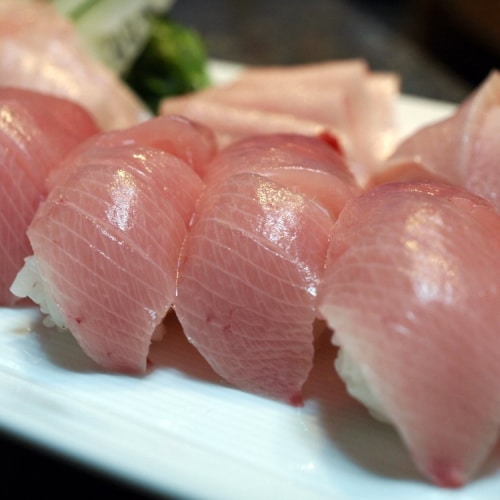
In the early 19th century, a man by the name of Hanaya Yohei conceived a major change in the production and presentation of his seafood. No longer wrapping the fish in rice, he placed a piece of fresh fish on top of an oblong shaped piece of seasoned rice. Today, we call this style ‘nigiri zushi’ (finger sushi) or “edomae sushi” (from Edo, the name of Tokyo at the time) and is now the common way of eating the Japanese style.
At that time, sushi was served from stalls on the street and was meant to be a snack or quick bite to eat on the go. Served from his stall, this was not only the first of the real “fast food,” but it quickly became wildly popular. From his home in Edo, this style of serving rapidly spread throughout Japan, aided by the Great Kanto earthquake in 1923, as many people lost their homes and businesses and moved from Tokyo.
After World War Two, the stalls were shut down and moved indoors, to more sanitary conditions. More formal seating was later provided (the first iterations were merely an indoor version of the outdoor stalls) and sushi changed from ‘fast food’ to a true dining experience. This new way of preserving and eating seafood spread around the globe, and with the advent of the promotion of seafood, this unusual style of serving seafood was quickly adopted by western cultures, always eager for something new, especially something that had grown as sophisticated and unique as this new style of food.
Modern Dining
Sushi, the artful dining experience once uniquely Japanese, has now evolved to another level beyond the traditional Japanese methods. Western influences have given rise to new styles of sushi, such as California rolls and the many elaborate ‘fusion’ creations at upscale sushi restaurants. The history of sushi is a long one, at least 1,800 years in fact, but the current iteration is popular around the world, and rightly so. It is not often that something so singly cultural can not only take the world by storm, but also influence the direction of food in other cultures.
Demand for sushi is only increasing and seems to be continuing to evolve. Traditional sushi restaurants sit alongside ‘fusion’ restaurants and both are popular for their own reasons. So while it began as a very simple product long ago, we now have so many different types of what we generically refer to as “sushi,” from the traditional nigiri sushi (seafood on a bed of rice), maki sushi roll, the tempura roll, the cone shaped <u, and many more. And it now even contains ingredients never originally imagined in Japan or China such as cream cheese (in the “Philadelphia roll” found typically in the United States), and sanitary techniques such as covering the bamboo rolling mat with plastic wrap to control cross-contamination. Sushi may have a long backstory, but the history of sushi is still far from over.
I have always been fascinated by the creation and culture of different foods, particularly sushi and sashimi in the modern era of Japanese cuisine. I am a classically trained chef and sushi connoisseur, also having operated a food service company and enjoy investigating and experimenting with food around the world.