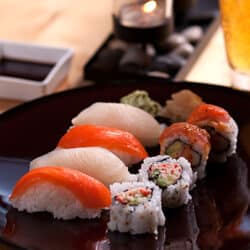
Sushi has always seemed fascinating, not just as food but as a cultural practice. While there aren’t any strict rules for sushi etiquette in today’s world, other than basic politeness and fairness, there are some traditions that may enhance your dining experience. At certain traditionalist restaurants, following these customs might even catch the staff’s attention in a positive way.
You’re not expected to know every sushi tradition, and that’s perfectly fine. Many people don’t, even in Japan. While some of the tips that follow may seem obvious, I hope they provide a little extra insight for those who love sushi but perhaps only enjoy it once in a while.
Learning sushi etiquette is easy and enjoyable! Take Jiro Ono, for example, one of the most respected sushi chefs in the world. As the owner and itamae of Sukiyabashi Jiro, a famous sushi restaurant in Tokyo, he’s known for revolutionizing sushi and sashimi with his innovative techniques, all while staying true to the art of traditional sushi making.
Now, keep in mind, this list isn’t set in stone, and is simply information for traditionalists. Thus, It’s more of a guide than a strict rule-book. Don’t stress about memorizing these tips every time you head out for sushi. In fact, many Japanese people don’t follow all these rules to the letter either, manners and traditions evolve over time, and we live in a new era. Good behavior is usually enough to ensure a pleasant meal, whether you’re at a sushi-ya or any other restaurant, especially in the West.
We’re not presenting these traditions as rigid rules. Instead, we hope they offer a glimpse into the rich history of sushi dining. Think of them as helpful information, not mandatory instructions. So, feel free to enjoy your sushi experience without worrying too much about getting every detail right!
Arriving and being seated
It is polite in any restaurant to greet the host or hostess, who may greet you with the traditional “irasshaimase” which means “please come in.” You just need to acknowledge their greeting and are not required to say anything back, other than to answer the questions about your evening (seating, etc.). Don’t feel like you are impolite if you don’t respond, it’s not essential to sushi etiquette, but no one will ever begrudge you for a smile!
If you are interested in watching your food preparation or conversation with the itamae (sushi chef), ask to be seated at the sushi bar, otherwise a table is fine (and the bar better left for those who would prefer the interaction).
Ordering
If you are seated at the sushi bar, only ask the itamae for sushi. Drinks, soup, and other non-sushi (or sashimi) items are handled only by the waiter/waitress.
Ask the itamae what he would recommend, but never “is that fresh?” as it is insulting to imply that something may not be. If you think it may not be fresh, you shouldn’t be eating there, however a good itamae will steer a diner towards the foods he feels will be most satisfying and highlight his skills. Sometimes learning how to eat sushi is just knowing your manners!
Respect the itamae, he is often quite busy. But feel free to engage him in conversation if he is able. This is also a good way to build a rapport with him and you may reap the rewards later as a regular (I really have with one particular itamae at one of my favorite places).
Keep your palate in mind and order accordingly. It is impolite to leave food on your plate after your meal or act as though a particular item is “gross” if you don’t like it.
How to eat sushi: the dining etiquette
You may be offered a hot, wet towel (called an oshibori) at the beginning of your meal. Use it to wash you hands and try to fold it back neatly the way it was offered to you before returning it.
Do not rub your chopsticks together. When not in use they should be placed parallel to yourself on the holder (if there is one) or on the shoyu dish. They should also be placed there when finished with your meal.
Don’t be afraid to ask for an item not on the menu as the sushi-ya may have special or seasonal items that are not listed. It is perfectly acceptable to ask, and often the itamae will appreciate your interest.
Don’t put wasabi directly in the shoyu dish. Nigiri-zushi (fingers of rice topped with fish or another topping) comes with wasabi placed under the neta (fish) by the itamae, and reflects what he feels is the proper balance of wasabi to fish. Some of us like a little more, and you can always sneak some separately on the fish or with it.
It is OK to eat nigiri-zushi (sushi) with your hands. Sashimi is only to be eaten with your chopsticks.
Pick up the nigiri-zushi and dip the fish (neta) into your shoyu, not the rice (which will soak up too much shoyu). The rice is like a sponge, and too much shoyu will overpower the taste of the food and could also lead to the rice falling into your shoyu dish and making soup, which is not a good thing.
Do not pick up a piece of food from another person’s plate with the end of the chopsticks you put in your mouth. When moving food like this use the end you hold, which is considered the polite way.
Eat nigiri style sushi in one bite. This is not always easy (or possible) in North America where some sushi-ya make huge pieces, but traditional itamae in Japanese sushi-ya will make the pieces the proper size for this. In North America, try your best and don’t worry if there’s possible way to fit the entire thing in your mouth! It’s not up to you to have proper sushi etiquette if it’s physically impossible.
Gari (ginger) is considered a palate cleanser and eaten between bites or different types of sushi. It is not meant to be eaten in the same bite as a piece of sushi.
Slurping noodles is OK, less so for soup, but a bit is fine, at least by Japanese standards.
In more traditional sushi-ya, if you are not given a spoon for your soup, do not ask for one. You are expected to pick up your bowl to drink the soup, using your chopsticks to direct the solid pieces to your mouth.
It’s nice to offer a beer or sake to the itamae (but of course not required). He may remember you and treat you well upon subsequent visits.
Never pass food to another person using chopsticks as this is too close symbolically to the passing of a deceased relative’s bones at a traditional Japanese funeral. Pass a plate instead allowing an individual to take food themselves.
Also, never stick your chopsticks in your rice and leave them sticking up. This resembles incense sticks and again brings to mind the symbolism of the Japanese funeral and prayers to one’s ancestors.
Technically one doesn’t drink sake with sushi (or rice in general) only with sashimi or before or after the meal. It is felt that since they are both rice based, they do not complement each other and therefore should not be consumed together. Green tea is a great option with sushi or sashimi.
With alcoholic beverages, it is considered customary to serve each other (if not alone) instead of pouring one’s own drink. Be attentive of your fellow diner’s glasses and refill them. If you need a refill, drink the remainder of the beverage and hold the glass slightly and politely towards a dining partner.
It is customary for the most “prestigious” person at the table to pour the drinks. Serving of drinks is very hierarchical in nature. Example: a professor who dines with his students would pour the drinks. Upperclassmen would serve the freshman. If not by prestige, it would be the host of the evening or who invited the quests. If you invited someone to dine with you, you become the automatic host.
Sake is available both chilled and hot, depending the quality and style. Experiment to learn what you like, but generally, higher quality sake is served cold. And some is quite good as well as sophisticated.
Belching is considered impolite at the Japanese table, unlike some other Asian cultures. This is a no-no for sushi etiquette.
“Kanpai!” (“empty your cup”) is the traditional Japanese toast you may hear. Do not say “chin chin” as to the Japanese, this is a reference to a certain male body part best left out of proper conversation.
After the meal
If you sit at the bar, tip the itamae for the food (in western countries there is often a tip jar as the itamae will never touch money since he touches food) and the wait staff for the drinks etc. Otherwise, tip as you normally would.
It is polite to thank the itamae if you were seated at the sushi bar. If you want to try Japanese, “domo arigato” is a polite Japanese expression for ‘thank you’ and if you want to be more sophisticated (for a westerner), you might try “gochisosama deshita,” which loosely translated means “thank you for the meal.” You can use the less commonly used “oishikatta desu” (it was delicious), however this is rarely used.
In Japan, tips are included in the bill, but in North America, tip as you see fit.
I hope that his provides some insight into the sophisticated evolution of the sushi dining experience and that you now feel as though you know how to eat sushi. This is not an exhaustive list, but certainly large enough for a general guide.
Again, please treat this exposition as a list of guidelines and not as hard and fast rules. I have provided this as a reference and an article of interest, not as something to worry westerners who think they ‘might be doing it wrong.’ Enjoy your meal as you normally would, and have fun. That is really the purpose of going out to eat.
I have always been fascinated by the creation and culture of different foods, particularly sushi and sashimi in the modern era of Japanese cuisine. I am a classically trained chef and sushi connoisseur, also having operated a food service company and enjoy investigating and experimenting with food around the world.